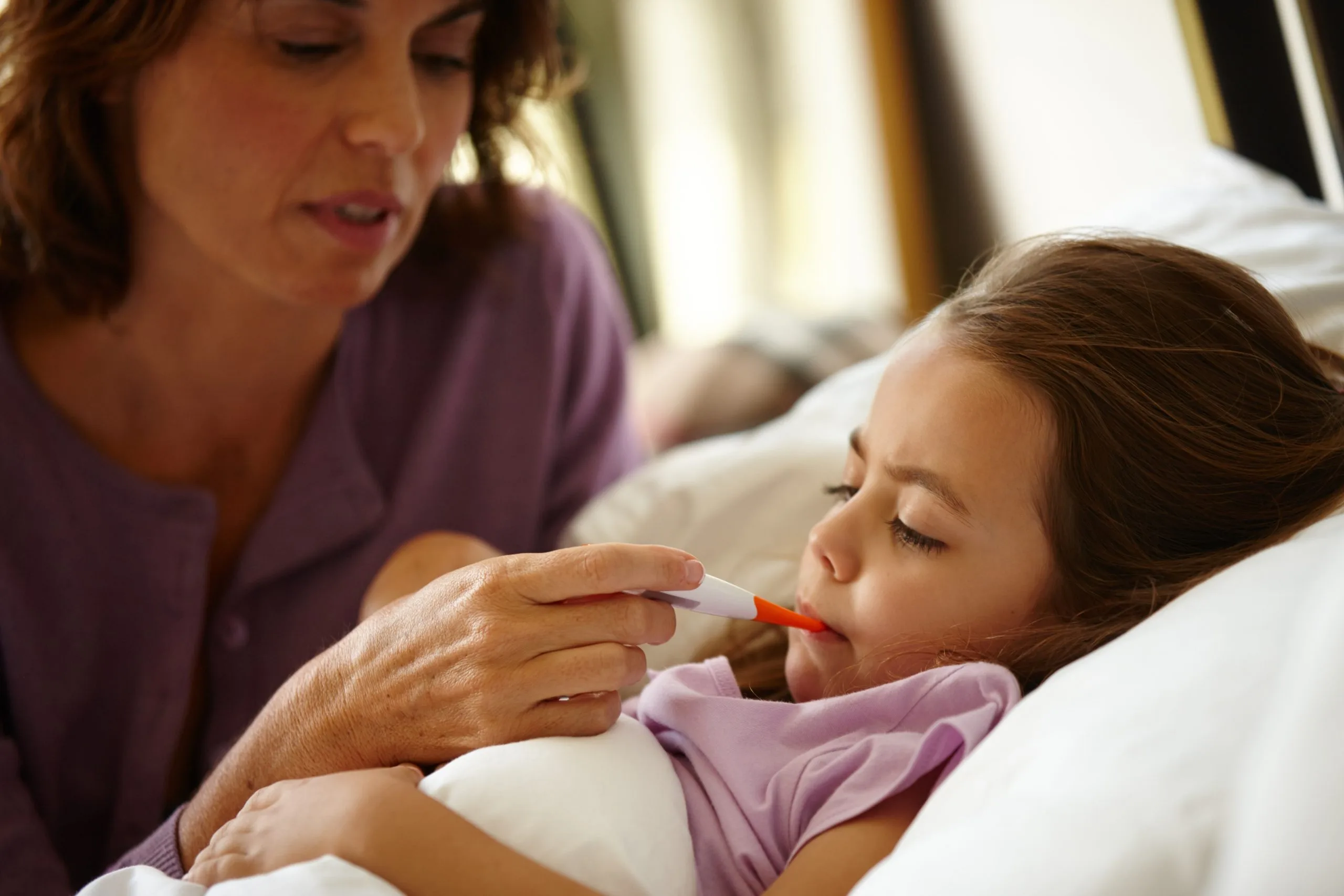
A child older than 3 months should be seen at urgent care if the fever is 102.2°F (39°C) or higher, if it has lasted more than 2–3 days, or if it comes with ear pain, a sore throat, a cough, a rash, or signs that your child isn’t drinking or acting like themselves. Babies under 3 months with a temperature of 100.4°F (38°C) or higher, and any child with trouble breathing, a stiff neck, or a seizure, need the emergency room right away.
The rest of this guide helps you sort out which situation you’re in.
A fever is not an illness. It’s a sign that your child’s immune system has switched on. Raising body temperature makes it harder for germs to multiply and helps immune cells work faster.
Doctors generally define a fever as a temperature of 100.4°F (38°C) or higher. A number is only part of the picture, though, and it’s often not the most important part.
Where you should go depends heavily on your child’s age.
This is the one group where we don’t wait and watch. A fever of 100.4°F or higher in a newborn or young infant should be treated as an emergency. Their immune systems are still developing, and a serious infection can move quickly. Go to the ER, and don’t give fever medicine before a doctor has examined your baby.
This age group often runs high fevers, and they can’t tell you what hurts. Urgent care is a good choice if your child has a fever of 102.2°F or higher, or a lower fever that keeps coming back, especially with fussiness, pulling at an ear, a runny nose, or poor appetite.
Older kids can usually tell you what’s wrong, which makes your job easier. A sore throat, belly pain, burning when they pee, or an earache alongside a fever are all good reasons for a same-day visit.
You don’t need to wait for your pediatrician’s next opening if your child is stable but clearly needs to be seen. Our urgent care team can step in when:
The fever is 102.2°F or higher in a child older than 3 months
The fever has lasted more than 2–3 days, or longer than 24 hours in a child under 2
Your child has ear pain, a sore throat, a cough, or sinus pain
There’s a new rash along with the fever
Your child is drinking less and peeing less than usual
The fever went away and came back
Your child has a known condition, such as asthma, that makes illness riskier
Evenings are when many parents feel stuck. Our Crystal City and North Arlington locations are open from 7 am to 11 pm every day, so a fever that spikes after dinner doesn’t have to turn into a long night of worrying.
Some symptoms are beyond what urgent care is built to handle. Head to the emergency room or call 911 if your child:
Has trouble breathing, is breathing very fast, or has skin pulling in around the ribs
Has a stiff neck, severe headache, or is bothered by bright light
Has a seizure
Is very hard to wake, confused, or unresponsive
Has a purple or red rash that doesn’t fade when you press on it
Shows signs of serious dehydration, such as no tears, a sunken soft spot on a baby’s head, or no urine for 8 hours or more
Has a fever that doesn’t ease at all, along with severe pain or a limp, floppy body
If a gut feeling tells you something is seriously wrong, don’t talk yourself out of it.
A fever is a symptom, so the real work is finding the cause. That’s where being able to test on the spot makes a big difference.
Strep throat. A sore throat with fever, especially without a cough, is a classic sign. A rapid strep test gives us results in minutes, so treatment can start right away if it’s positive.
Ear infections. A child who tugs at an ear, cries when lying down, or wakes up screaming may have one. Our team can look inside the ear and begin treatment for an ear infection the same day.
Flu, COVID, and RSV. These can look nearly identical at first. PCR respiratory testing can tell us which one it is, so you get a confirmed diagnosis instead of a guess.
Rashes with fever. Many viral rashes are harmless, but some need attention. If your child has spots along with a fever, our rash treatment team can take a look.
Urinary tract infections. These are easy to miss in young children, especially girls, and a quick urine test can solve the mystery.
Because we run labs on-site, many of these answers are ready before you leave the building. That means fewer follow-up calls and a clearer plan for the night ahead.
While you’re deciding whether to come in, a few simple steps can keep your child comfortable:
Offer fluids often. Small, frequent sips work better than big gulps. Water, diluted juice, broth, and popsicles all count.
Dress them lightly. Bundling up traps heat and can raise the temperature.
Use fever reducers carefully. Acetaminophen can be used for children over 3 months, and ibuprofen for those over 6 months. Always follow the dosing chart for your child’s weight, and never give aspirin to a child.
Skip the cold baths and alcohol rubs. They cause shivering, which can make things worse.
Write things down. Note the temperature, the time, any medicine given, and any new symptoms.
Walking into a clinic with a sick child can feel stressful, so here’s what usually happens. A provider will check your child’s temperature, heart rate, breathing, ears, throat, and belly, and ask about how long the fever has lasted, what your child has been eating and drinking, and who they’ve been around. Depending on what we find, we may run a quick test.
You’ll leave with a clear plan: what’s causing the fever, what to do at home, and the specific signs that should prompt you to return or go to the ER. If a visit shows your child needs a higher level of care, we’ll tell you plainly and point you to the right place.
Bring along:
Your insurance card, or ask about our self-pay rates
A list of any medicines your child takes and what you’ve given for the fever
Your child’s vaccine record, if you have it
A favorite toy or blanket, because comfort items help during exams
We work with many major insurance plans, and you can verify your coverage before you come in.
Urgent care is perfect for the evening spike or the weekend fever. But kids do best when they also have a doctor who knows them. Our pediatric team offers same-day sick visits as well as well-child checkups, and keeping up with immunizations and vaccines is one of the best ways to lower the odds of serious fevers in the first place.
If you remember nothing else, remember this:
Under 3 months with a fever of 100.4°F or higher: go to the ER now.
Older than 3 months with a high or lingering fever, or fever plus ear, throat, or cough symptoms: urgent care is the right place.
Trouble breathing, seizure, stiff neck, unresponsiveness, or a rash that doesn’t fade: call 911 or go to the ER.
Not sure? Call us. We’d rather answer a question than have you lie awake wondering.
You can find us at Crystal City, North Arlington, or Annandale, and our team is ready to help whenever your child’s fever has you worried.
Disclaimer: This article is for general educational purposes only and is not a substitute for professional medical advice, diagnosis, or treatment. Always seek the advice of your child’s physician or another qualified health provider with any questions about a medical condition. If you believe your child is experiencing a medical emergency, call 911 or go to the nearest emergency room immediately.

About the Author
Haroon Rashid, MD, FACP

October 2, 2026
TESTING
ILLNESS & INFECTION
INJURIES & WOUNDS
PHYSICALS & CLEARANCE